
Managing a server involves much more than keeping it online. Administrators must monitor services, investigate logs, install updates, renew certificates, maintain backups and respond quickly when something goes wrong.
Control panels such as Plesk, cPanel and DirectAdmin make many of these tasks easier. However, diagnosing an unusual problem can still require several tools, terminal commands and a good understanding of how the server is configured.
AI server management tools are beginning to simplify this work. Instead of manually checking every part of the server, an administrator can describe the required result in plain English and let the system investigate the problem.
1. What Is AI Server Management?
AI server management is the use of artificial intelligence to inspect, maintain and troubleshoot servers.
A basic AI assistant may suggest commands for an administrator to run. A more advanced system can connect to the server, examine its current condition, create a plan and perform approved actions.
A useful AI server management platform should be able to:
- Understand a request written in normal language
- Inspect the live server before making changes
- Select the appropriate server operations
- Ask for approval before performing sensitive actions
- Verify that the requested result was achieved
The verification stage is particularly important. A command completing successfully does not always mean that the original problem has been solved.
For example, a web service may restart successfully but fail again a few moments later. An SSL certificate may be installed but the website may still display the wrong certificate. Verification helps identify these situations.
2. Why Server Management Takes So Much Time
Many server problems are small but time consuming.
A website may stop working because of incorrect permissions. Email delivery may fail because a mail queue is full. A domain may be using the wrong PHP version. A database service may be consuming too much memory.
Solving these problems normally requires the administrator to check several parts of the server.
The administrator may need to examine logs, review service status, inspect configuration files and compare the current setup with the expected setup. Even when the solution is simple, finding the cause can take time.
AI can shorten this process by collecting the relevant information and connecting it to the reported problem.
3. How BashPilot Approaches Server Management
One platform working in this area is BashPilot.
BashPilot connects to a server through a lightweight Go agent. The agent works locally on the server and communicates through an encrypted outbound connection. This means that a new inbound management port is not required.
The platform supports common hosting and Linux environments, including Plesk, cPanel and WHM, DirectAdmin, Docker and Kubernetes.
When working with Plesk, BashPilot uses native Plesk command line tools. This allows changes made through the AI system to remain consistent with the information shown inside the Plesk panel.
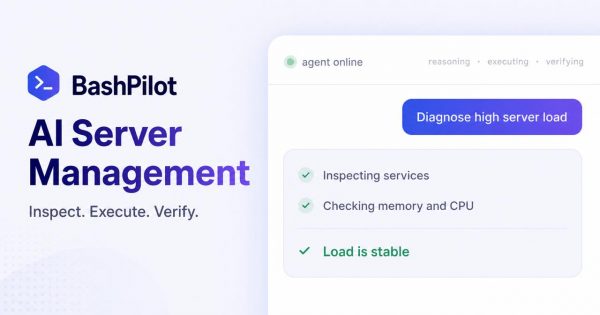
The general process is simple. The user describes the required result, BashPilot inspects the server, prepares a plan, performs the approved actions and checks the final result.
4. What Types of Tasks Can AI Handle?
The exact capabilities depend on the platform and server configuration, but AI server management can assist with several common tasks.
Website Problems
AI can investigate unavailable websites, permission errors, web server problems and configuration issues.
SSL Certificates
It can help diagnose failed certificate renewals, incorrect certificate assignments and common HTTPS problems.
Email Issues
AI can inspect mail services, queues, logs and settings when messages are delayed or rejected.

PHP Configuration
It can assist with PHP versions, handlers, extensions and settings required by individual websites.
DNS Management
AI can examine DNS records and identify missing or incorrect entries that may affect websites and email.
Database Problems
It can check database services, connections and resource usage when an application cannot access its database.
Server Performance
AI can inspect memory, processor load, disk usage and running services to help locate the source of a performance problem.
Security Tasks
It can assist with firewall rules, blocked addresses, failed login protection and other routine security operations.
5. Automation Must Include Safety Controls
Giving software the ability to make server changes requires strong controls.
An AI server management platform should not convert every request into an unrestricted terminal command. It should use known operations, explain what it intends to do and request approval for actions that could remove data or interrupt services.
Administrators should also be able to review a record of the actions performed.
This creates accountability and makes it easier to understand how a server reached its current state. It is especially important when several administrators or support agents are responsible for the same infrastructure.
Sensitive credentials should remain protected, and the system should only receive the access required to complete its work.
6. Will AI Replace Server Administrators?
AI is unlikely to remove the need for experienced server administrators.
Complex migrations, unusual security incidents, infrastructure design and business critical decisions still require human judgement. An AI system may collect information and suggest a plan, but an experienced administrator must understand the wider consequences of important changes.
The more practical role for AI is to handle routine investigation and repeatable maintenance.
It can provide a faster first response, gather diagnostic information and complete common tasks under human supervision. This gives administrators more time to focus on security, planning and complicated infrastructure work.
7. Who Can Benefit From AI Server Management?
AI server management may be useful for:
- Hosting companies managing many customer servers
- Web agencies responsible for client websites
- Developers maintaining their own applications
- Small businesses without a full time system administrator
- Support teams dealing with repeated server problems
- Experienced administrators who want to reduce routine manual work
The value is not limited to people without technical knowledge. Experienced administrators can also use AI to speed up investigation and avoid repeating the same maintenance steps across many servers.
Conclusion
AI is becoming a practical addition to server management.
It can help administrators understand problems faster, perform approved operations and verify whether the expected result was achieved. When combined with clear permissions, activity records and human oversight, it can reduce the time spent on routine server work.
Platforms such as BashPilot show how this approach can work with existing hosting environments instead of requiring companies to replace their current control panels or server infrastructure.
Human experience will remain important, especially for security and complex infrastructure decisions. However, AI can become a useful assistant for the everyday work involved in keeping servers secure, stable and available.

Leave A Comment